

March 2026 Toronto Real Estate Update: The Spring Market Is Awake… But Still Hitting Snooze
If this spring market had a personality, it would be that person who says, “I’m on my way” while still standing in their kitchen.
That’s kind of the vibe right now.
After a very slow start to the year, March finally showed a few signs of life across the GTA. Not a dramatic, kick-the-door-down kind of comeback. More of a cautious “okay fine, I’ll come outside” energy. Sales improved slightly, prices remained softer than last year, and buyers continued to benefit from something we haven’t seen much of in recent years: breathing room.
The GTA Market: Slowly Warming Up
According to TRREB, there were 5,039 home sales across the GTA in March, up 1.7% compared to March 2025. At the same time, the average selling price came in at $1,017,796, down 6.7% year over year. Prices were fairly stable compared to February, but still lower than they were this time last year. Active listings also declined, down 8% year over year.
What does that mean in plain English?
Buyers still have leverage.
There is more room to negotiate, less pressure than we’ve seen in hotter spring markets, and more opportunity to think before making a major decision. A novel concept in Toronto real estate, I know.
TRREB’s Chief Information Officer Jason Mercer noted that buyers continued to benefit from substantial negotiating power across major market segments in March. That helps explain why average selling prices are lower year over year. But if conditions continue tightening, prices could begin to level off through the rest of 2026.
Toronto Proper: Similar Story, Slightly Different Details
Looking specifically at Toronto, the numbers tell a similar story.
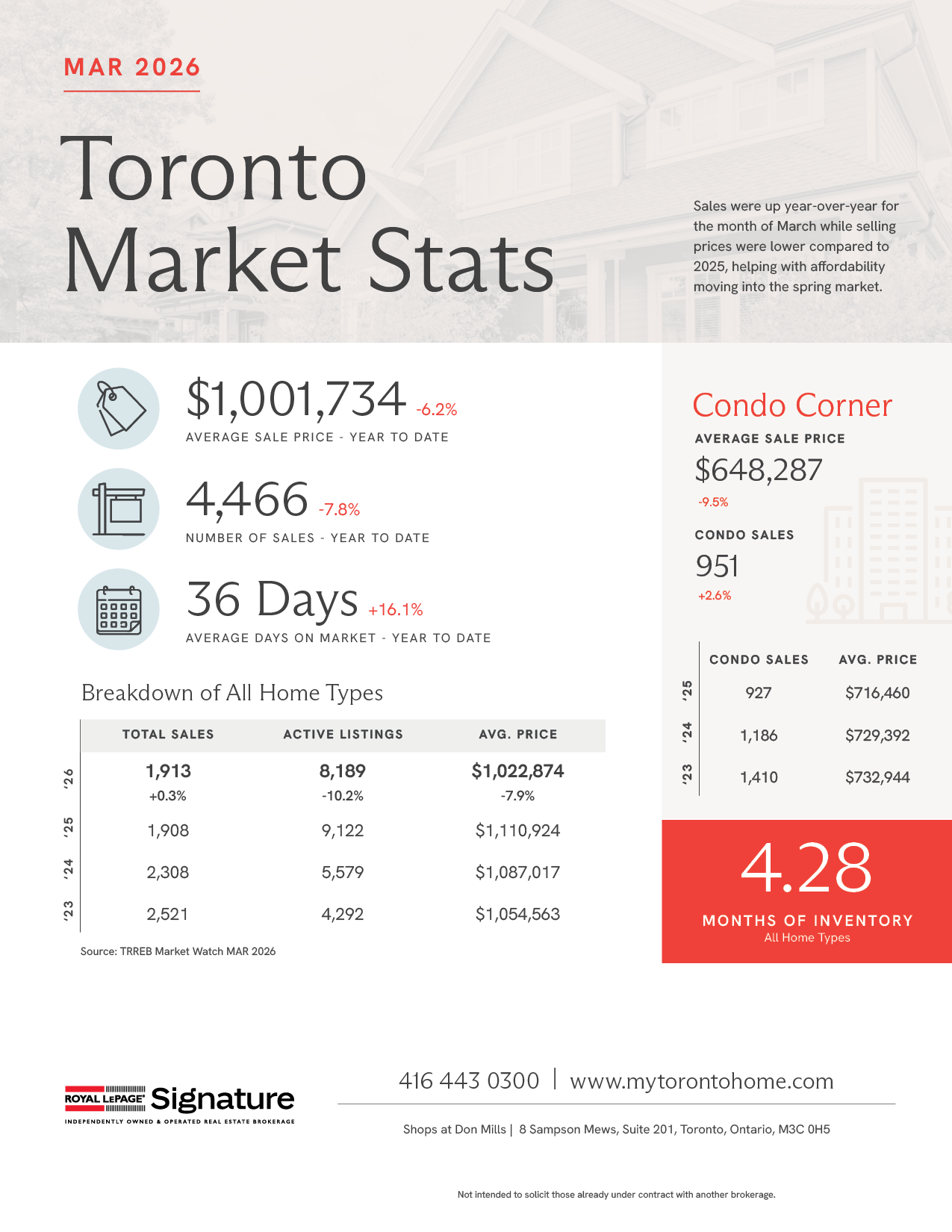
Year-to-date, the average sale price sits at $1,001,734, down 6.2% from last year. The number of sales is 4,466, down 7.8% year over year. Homes are taking about 36 days to sell on average, which is 16.1% longer than last year. Toronto is currently sitting at 4.28 months of inventory, which puts us in a much more balanced market than buyers and sellers have gotten used to over the past few years.
And in the condo market, the average Toronto condo price is now $648,287, down 9.5% year over year, while condo sales are up 2.6%, with 951 sales year to date.
So no, the market isn’t exactly hot.
But it is interesting.
And interesting markets tend to create opportunities for people who are paying attention.
Why the Market Still Feels Cautious
Even though the fundamentals for real estate remain solid, confidence has taken a hit. That has been one of the biggest themes of this market.
A long winter did not exactly inspire people to get out house hunting. On top of that, ongoing uncertainty around trade, geopolitics, interest rates, and the broader economy has made many buyers and sellers more hesitant than usual. The result is a market that feels slower, not because people no longer need housing, but because many are waiting for more clarity before making a move.
That distinction matters.
Because the demand for housing has not disappeared. In fact, the broader need for housing in our region continues to grow, even while sales activity remains subdued.
The Bigger Issue: Supply
One of the most important parts of this conversation is not just what is happening today, but what is coming.
New housing construction across the GTA has slowed dramatically, and that is becoming a serious long-term concern. Over the past three years, new residential development has declined by more than 90%, and the pipeline for future condo completions is shrinking fast. That creates a real risk that today’s softer market could eventually turn into tomorrow’s supply crunch.
In other words, while some people are focused on today’s slower pace, the bigger story may be what happens when demand remains and new supply does not.
That is exactly why the recent government announcements around HST relief and development charge reductions are such a big deal.
The New HST Rebate: What Buyers Should Know
Beginning April 1, 2026 and running through March 31, 2027, the Ontario government, in partnership with the federal government, is offering a full HST rebate of up to $130,000 on eligible new homes valued up to $1 million. Homes valued between $1 million and $1.5 million also qualify for the full rebate. Homes between $1.5 million and $1.85 million receive a reduced rebate on a sliding scale, and homes above that threshold continue to receive only the provincial rebate of $24,000. Importantly, the program applies not just to first-time buyers, but also to repeat buyers and investors.
That is a meaningful shift.
Many developers are already heavily promoting their remaining inventory because these rebates create much more attractive price points for buyers. The goal is to stimulate new home sales, support construction activity, and help address the GTA’s ongoing housing shortage. Details on municipal development charge relief are still being finalized, but the signal from government is clear: supply is a problem, and they know it.
What This Means for Buyers and Homeowners
For buyers, there is still real opportunity here.
You have more negotiating power than you’ve had in years. Prices have come down from peak levels. There is less chaos, less blind bidding madness, and a little more time to make smart decisions without feeling like you need to offer your firstborn and waive every condition by dinner.
For homeowners, especially those thinking about upsizing, downsizing, or making a strategic move, this market may offer options that simply did not exist a few years ago. In the right situation, softer pricing and more balanced conditions can create a very smart window to move from one property type to another.
That said, real estate is never one-size-fits-all. What makes sense for one person may not make sense for another. Some homeowners may find that now is a great time to move. Others may be better off holding a strong property and waiting. The difference comes down to strategy, timing, and understanding your specific micro market.
Bottom Line
March gave us a market that is showing signs of life, but still moving carefully.
The GTA saw sales rise modestly, while prices remained lower than last year. Toronto itself continues to feel more balanced, with more time on market, more inventory than we’ve seen in a while, and softer pricing, especially in the condo segment. At the same time, the long-term issue of housing supply is getting harder to ignore, which is why new build incentives and government intervention matter so much right now.
So no, this is not the wild, chaotic Toronto market we saw a few years ago.
But boring? Not even close.
It is a more strategic market. A more thoughtful market. And for the right buyer or seller, that can be exactly where opportunity lives.
If you’re thinking about making a move and want to talk through what these numbers mean for your neighbourhood, your home, or your next step, I’d be happy to help.
Have questions?
Want to know more about Toronto Real Estate Market Update March 2026: GTA Sales Rise While Prices Stay Soft? Send me a message and I'll get back to you within 24 hours.